
Deserts are often seen as barren landscapes of sand and harsh sunlight. Yet, beneath this seemingly empty surface lies a complex, living ecosystem—an intricate web of relationships between plants, insects, birds, rodents, and other creatures. Each plant, shrub, or tree in the desert is more than just flora; it is a microecosystem, a world supporting tiny but vital creatures that depend entirely on it for food, water, and shelter.
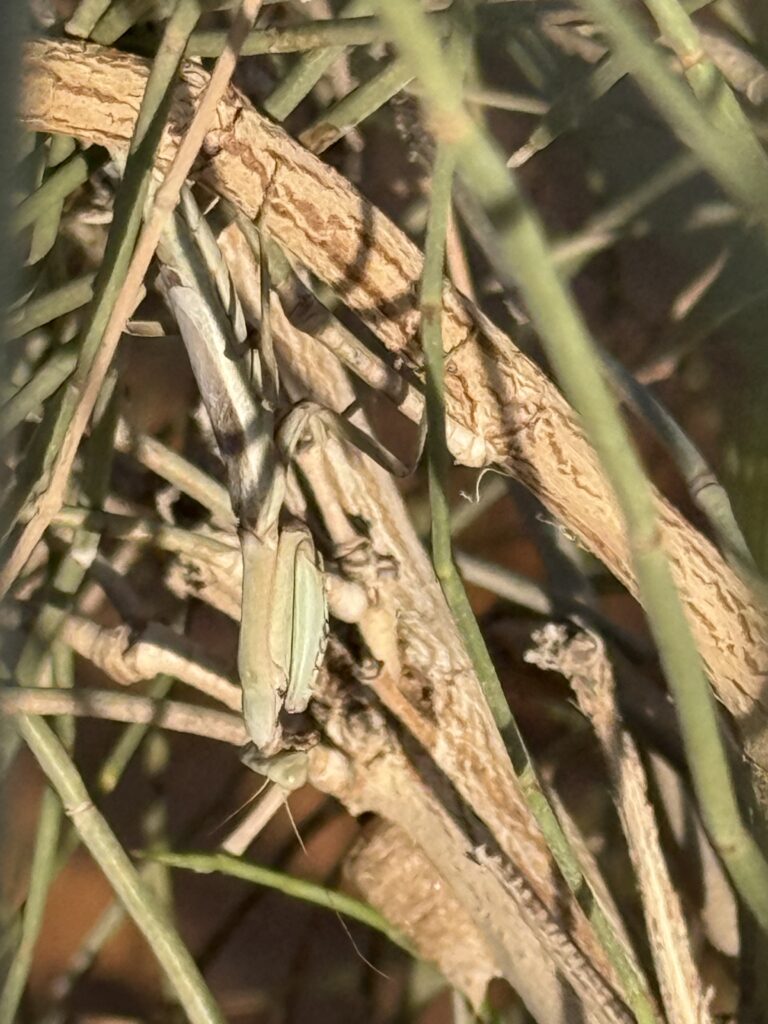
During a recent exploration in the Al Ain desert, I paused under a Calligonum comosum shrub and observed a praying mantis—locally known as martis—perfectly camouflaged. Its body matched the pale, slender branches of the shrub so precisely that it almost disappeared. Only a subtle movement revealed its presence. This is a vivid example of cryptic coloration, a survival strategy that allows tiny insects to remain safe from predators in a desert where shelter is scarce.
Cryptic Coloration: Survival in a Harsh Environment
In deserts, life faces extreme challenges. Water is almost nonexistent, sunlight is intense, and predators abound. To survive, many species have evolved cryptic coloration, blending with the environment to avoid detection.
For the praying mantis in the Calligonum comosum bush, this camouflage provides protection from birds, lizards, and other predatory insects. At the same time, it improves hunting efficiency, allowing the mantis to ambush unsuspecting prey. This demonstrates how evolution shapes both appearance and behavior, finely tuning organisms to their environment.
The Bush as a Microecosystem
The Calligonum comosum shrub is more than a plant—it is a microhabitat supporting a diversity of life:

- Its branches provide shelter for insects like martis, flies, and bees.
- Small birds and rodents use it for shade and safety.
- It retains minimal moisture and collects dew, offering water to tiny creatures.
- Its flowers and seeds serve as a food source for herbivorous insects and small mammals.
Even in a desert with no nearby water, life thrives entirely around this shrub. Each plant becomes a small oasis, sustaining complex interactions and demonstrating the resilience of desert ecosystems.
Observing such interactions underscores a key lesson of ethnoecology: desert communities have long recognized that life here is organized, interdependent, and intelligent. Every plant and animal is finely adapted to survive under extreme conditions. Cryptic coloration, symbiotic relationships, and microhabitat specialization are all evidence of this ecological sophistication.
Ethnoecology and Desert Wisdom
Through centuries of observation, local knowledge has emphasized that even the tiniest creatures are crucial to the balance of the desert. The martis, flies, bees, rodents, and birds each play a role, and without the shrubs and bushes like Calligonum comosum, this fragile balance would collapse.
A Lesson from the Field
During my exploration, watching the mantis blend into its environment was a reminder of the resilience and intelligence of desert life. The desert teaches patience, observation, and respect. Life here survives not despite harsh conditions, but because it has adapted and harmonized with its surroundings.
Every bush is a microcosm of survival, every insect a testament to evolution, and every subtle adaptation a story of resistance, endurance, and interdependence. Observing these interactions helps us appreciate that deserts are not empty sands, but living, functioning ecosystems deserving of study and protection.

Conclusion
The observation of a camouflaged praying mantis in a Calligonum comosum shrub highlights the importance of desert flora as microecosystems. Cryptic coloration allows tiny creatures to survive in a harsh environment, while the shrubs support an entire community of life. Deserts are ecosystems of resilience, adaptation, and interconnection, and every small observation reminds us of their hidden complexity. Protecting these systems ensures the survival of countless species that depend on them for life.
