
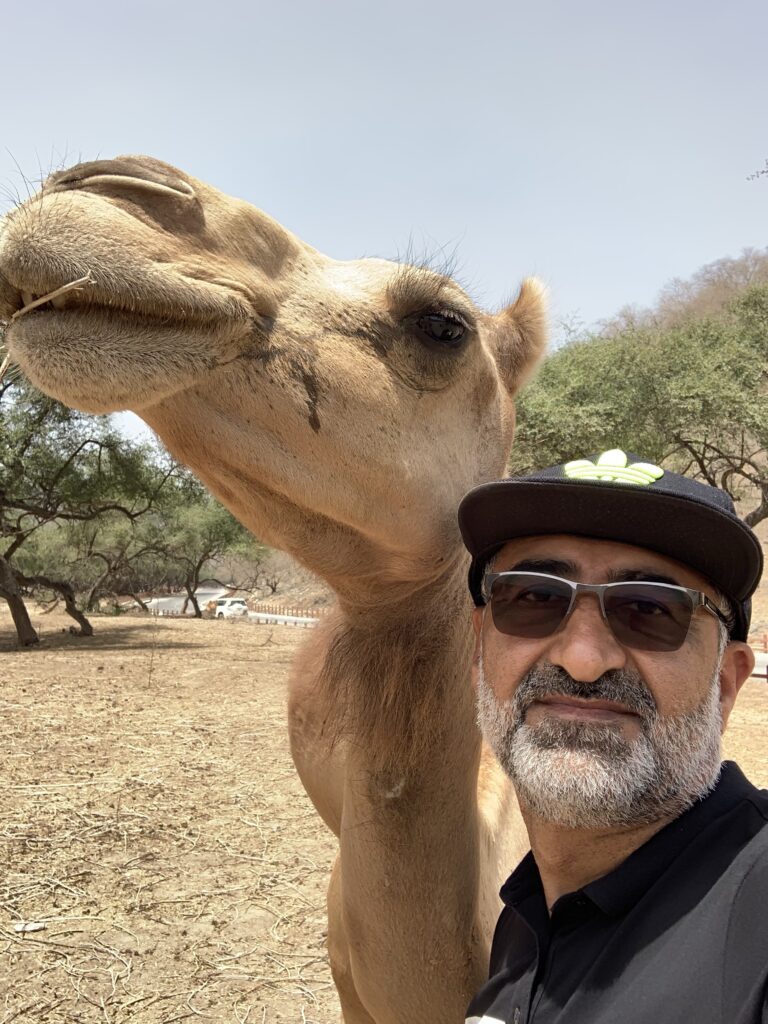
Synonyms: Khawarah and Dhofari camel breed
Habitat of the Breed – Land of Frankense is the Land of Khawarah
The Khawar or Khawarah breed of the camel is found in the Southeastern Arabian Peninsula but the herds of true specimen breeds are found in the Dhofar region, especially Salalah. The nucleus herds of the breed with purity are found in the mountainous region of Salalah, where they can browse on good woody vegetation of comb-tree (Anogeissus dhofarica), Acacia, and other trees and shrubs. Dhofar is centric on the frankness trade and history of the region. Almost 60% of the Omani camels are inhibited in the Dhofar region which is predominantly comprised of the Dhofari or Khawar breed followed by MAHALI (a thorough crossbred of Khawar, Majaheem, and Brela). Such a combination is also called a MUHAJAN or Majajan.

Salient features of the Khawarah camel
Khawarah camels are beautiful, having dark brown, light brown, fawn, reddish, white, and creamy red colors. Color diversity comes with the diversity of landscapes and ecosystems. With a medium-sized head, the breed has a deer’s mouth (Their lower lip is not hanging like other fellows of the desert). They have a medium head with a medium-sized neck and ears.


Almost 2 meters high, the body is slightly longer than the high and the camel has a very prominent barrel-like thorax, making it an excellent dairy camel. The camels have very beautiful angular ribs making a 45-degree against the vertebral columns. Medium in size, ranging from 250 to 350 kg live body weight. The size is slightly larger in the plain lands than in the mountain ecosystem, ranging from 300 to 400 kg live body weight. The breed is very friendly in nature and the cameleers treat them as their family member.

Why Khawarah is a good dairy camel?
Like other camel fellows, Khawarah is a multipurpose animal, performing many tasks for their owners but milk production tops the other features in the Khawarah camels. There are some very important arguments proving it is a Fashoosh camel. Fashoosh means a friendly camel with highly desirable teats and udder with very easy milking. Some people call Fashoosh as Hashoosh. https://arkbiodiv.com/2017/12/19/easy-and-fast-vs-the-difficult-and-slow-milking-camelsthe-arabs-traditional-knowledge/

A Future Dairy Camel
Based on my personal long experience with dairy camels, our best high-yielding and easy-milking camels are mainly from the Khawarah breed. I have been working with the world’s most modern and pioneer camel dairy in the world. They have medium-sized teats with strongly attached but deep udder. The teats are conical in shape and very well fit for the machine milking. They have very good milking ability and shorter actual milking time (AMT) in the machine milking because of their behavior and well-fit teat size.


Salalah is the future hub and the nucleus of pure Khawarah camel
Salalah is the hub of the Khawarah breed and the nucleus of the pure genetic pool. Here, the cameleers have maintained the pure genetic line of the breed and they have strong oral and traditional knowledge about the genealogy and husbandry of the breed. Here you can find the best specimens of the breeds with a promising yield of milk up to 35 kg/day. As the camel is slow in reproduction and the demand for the camel as a food security animal is ever increasing especially in the climate change scenarios, there is a pivotal need to establish a camel center where the best dairy camels can be maintained and propagated through modern reproductive techniques. The camel is the animal of the future and the next oil for the Arabian Peninsula and other camels’ habitats.
The Camel adapts a unique strategy to cope with the dry season
As mentioned in Quraan, ‘DO THEY NOT LOOK AT THE CAMEL, HOW STRANGE THEY ARE MADE’ the camel is unique and the animal of its kind. The camels cope with the dry season when there is very rare or no vegetation available. Only the twigs of woody flora, dried-out grasses, and bushes are available, the camels need strong and diverse microflora in their gut to digest such a woody feed. The camels start eating camel manure balls (CMB) of other camel fellows and the soil of the termites’ mounds. I have already written about this topic, the link is here https://arkbiodiv.com/2021/11/25/camels-and-termites-a-symbiotic-relationship-is-bridged-by-the-guts-microbiota/amp/. The termites’ mounds are a rich source of minerals.
Termite mounds are structures in several tropical ecosystems that are primarily built by termites (Jouquet et al. 2015). Soil from termite mounds is?rich in mineral nutrients and organic matter, and these make it a suitable habitat for microorganisms (Nithyatharani and Kavitha 2018).
They eat the CMB to fortify and diversify the gut microbiome. As termites have the most efficient microbiome in their gut to digest wood, bark, and other tough materials. While eating the termites’ dunes mud, they introduce such microbiome into their gut to digest the wood material of the dry season. If you notice, you can find one thing even more interesting when there are camels, the cows in the same ecosystem are healthy and flashy because of the introduction of the camel gut microbiome into the cattle gut. I noticed that the cows were very healthy in Salalah while the weather was dry and no vegetation was available. https://www.abc.net.au/news/rural/2013-07-11/cattle-camel-cograzing/4811026


Dairy companies are interested in camel milk
The interest of dairy companies is ever increasing in camel milk as there is a higher demand for camel milk in the regions where camels only exist in zoos or with hobby farmers. The Chinese market is one of the most important markets, especially for camel powder milk. The main driver behind the higher demand for camel milk is its health-promising characteristics. In the Salalah region, Almarooj has already launched its camel milk collection and processing project with a target collection of 4.32 million liters per year. https://www.omanobserver.om/article/1115283/business/markets/al-morooj-dairy-launches-first-camel-milk-based-products


The Cameleers have a complaint
The camelers keep their camels as their family members and each camel has its name. The cameleers want to sustain the camel profession that their forefathers have handed over to them. They are not looking to earn millions but they expect to have a return at least to sustain camel farming. The calamities of climate change, the higher stocking capacity, and land commercialization have shrunk the opportunities of natural herbage for the camels to eat and thrive. They need some surplus income to feed their camels properly as only grazing can’t support their feeding regime. The company collecting milk from the cameleers most of the time rejects the milk only based on the fat contents which can’t be justified. The fat, protein, lactose, ash, and other contents are naturally provided in the milk by the camel genome and the farmers can’t manipulate the chemistry of the milk. The milk derived from the camel udder is camel milk. It should not be rejected based on the chemical composition of the milk. Yes, it can be rejected if water is added, contaminated with antibiotics and chemicals or there is a high microbial count.

Good morning doctor, wonderful article. I spoke with two pastoralists at COP26, one from Kenya and one from Mongolia. There the subject of animals worth in terms of milk, meat, skin and breeding naturally arrived, which was always undermined by the middle-men who claimed to be in the know and have successively paid less for the animals sold to them. I encountered the same problem with camel stock in Mauritania, Mali, Morocco and Niger. The milk although lauded over and much acclaimed never brought the financial success it should have. Although one English woman opened up a dairy called Tiviski and one can buy ice cream, yogurt and cheese in Nouakchott. Take care.
My pleasure, thanks very much. Camel milk is now attracting many people from the non camel cultures which is a success.
Pingback: Khawara camel breed of Arabian Peninsula – Camel4ALL
I have the record of Dhofari or Khawarah camel, they have incredible milk production potential.
Very interesting article. It’s a record to reach 35 Kg of milk per day. Have you confirmed the milk production volume? Have you personally witnessed and measured the milk produced by a Naga? I think that the production of this is not solely attributed to genetic makeup; other factors, such as the environment and nutrition, also play a role. It is a pity that despite such potential for milk production, there is no single project currently being implemented to improve genetic capability within the breed through selection.
Dear Khalafalah,
Good day,
Yes, I confirm that I know about the 3 Potential milk breeds in camels. Some specimen of such breeds, a daily records (recorded by machine) have produced 35 and above liters of milk. Those 3 breeds are Brela (Pakistan), Majaheem (Saudi Arabia, Oman, and UAE), and Khawarah or Dhofari (Oman, Yemen, and UAE). I have the record with upto 150 days DIM peak yield, with a milking ability < 5 minutes). I'm telling the overall performance of the potential of camels. The statement that we have not worked on the camel as a dairy animal is not true. A lot of things have been done and manythings are in the process. We have now more than 200 camels producing > 20 kg milk (DIM peak yield 100+- days). We have many camels with a lactation yield of 8,000 liter and above.
The second row of best dairy breeds are Kharani (Balochistan), Aravana (Turkmenistan, Iran, Kazkhastan, Uzbekistan), and Hur breed (Somaliland, Somalia, Kenya, and Ethiopia).
Email response to Dear Pierre-Guy,
Good morning and thank you very much for your email and detailed information/feedback.
For the first time, I’m very much in agreement with you. Yes, the very Fashoosh/smooth milkingability leads to some issues. Here, in the milking parlor when the camels are parked and waiting for their number to be milked, the FASHOOSH camel starts leaking the milk in the waiting area. Such camels provide nutrients to the microbe, attract flies, and are prone to mastitis more than the other fellow camels.
Your second point is a bit debatable. We have camels from different genetic nuclei (mean breeds), having very diverse fat percentages. The same phenomenon is true for the other big farms.
Camels need good training (as camels are very intelligent) to remain calm during milking in the parlor. We are very good in this area. I always suggested the other cameleers just provide good training to the camels for milking. Otherwise, feeding carrots, Ottc, etc is not a sustainable solution. I introduced a bucket system in the parlor, providing some concentrate feed during milking but could not get the same results as with the training and personal camel care. Among 300 camels in milking present time, we don’t have any acute or chronic mastitis. The low fat also is linked with the lower fiber intake (if high protein TMR is provided for compensation high milk yield). In case alveolar milk remains in the udder, the camels join their calves after milking and stay with them for an hour or so. Then all the udder is cleaned/drained by the calves. I think this problem can be best solved with the provision of suckling to the calves.
Also, the season affects the fat percentage. The fat percentage is always lower in the peak production period which is always the mid-summer.
After reading your email, I checked/analyzed all the data we have for the milk composition, the fat contents are always higher than the protein contents. My point of view is to not establish the fat contents as a standard for the milk quality in camel milk (was my main point).
Thank you so very much. I shall copy and paste your email in the box under the article, so all the feedback remains with the article and open the door for discussion.
Thanks once again for your feedback.
Here is the email of Dr. Pierre from France.
Hi Dr Razik, because I don’t success to publish on line my comments under your article (the capcha verification don’t run correctly), i would like first to confirm the important point raised by moufida here and to share also some other remarks about two other points:
The first one is about milking ability and teat anatomy. It is clear that well shapped teat (conical, medium size) help as well manual than mechanical milking. It is precised in your text that quick milking is also an important point that is also true, but it must be precised that some teats have an anatomy allowing a too fast milking (short streak canal, important elasticity allowing canal dilatation, greater diameter and higher milk flow). Such teats must not be kept in flocks, neither selected by breeders because, in all species we have made studies on this point as cows, ewes and goats, a too important milk flow is also related to higher incidence of mastitis. Effectively, germs can more easily climb into the teat and gland if streak canal is more difficult to close after milking. It is always better to discard animals with too long milking duration and low milk flow that to select animals on basis of the better milk flow when you want to homogeneise and improve your flow to milking.
The second point is about decision of some dairy plants to refuse milk without enough fat content. I do not agree with you. It is not a so bad decision because breeders (and collectors) could have a big impact on this milk composition. Why? Fat content depend of 4 points: the first one is fat ingestion and thus quantity of food and equilibrium of the ration proposed to camels. OK, it is a point difficult to control by pastoralist that depend of the disponibility of forages. If the fat content is very low and even some times lower than the protein content, that could signify that the animals are not correctly fed (insufficient rumination by example). When milk is transformed, it could affect the process of clotting (not frequent with camel milk for sure). An analysis of type of fatty acid could could confirm that animals in this case generally mobilize their fat reserve and release mainly long fatty acid forms (C18 and more) in blood and thus in milk, that is not a good thing for human nutrition according to importance of a good ratio Omega 6-Omega 3 for atherogenicity of milk products. The second point explaining a low fat content is milk ejection. If camels are stressed, they don’t give their alveolar milk easily. The Fat is kept is alveoli and milk collected is very low in fat (for example, if you block milk ejection in dairy ewes, you can let in the udder after milking more than 75% of the fat!). Milk with low fat could correspond to milk obtained in bad conditions in stressed animals that is not good and do not be encouraged. Third and more important reason is udder health. When you have mastitis, fat content could be lowered because of a disrupted secretion process and because of fat degradation by somatic white cells and bacteria (in general, free fatty acids increase a lot). The last point is may be the more important and is linked to milk conservation. If milk is not well conserved, with no cold chain respect and long travel to the plant in hot climate, the bacterial content of milk can explode ad these bacteria can reduce fat content as explained before. When the only and/or cheaper method for milk quality control is fat and protein content, it is thus logical to use fat content as a decision tool for accepting milk or not at the plant!
regards
Your comment is very beneficial for the future, you have written in a very beautiful way, you have an inspiration for the youth who come to your comment is really very beautiful, nowadays children do not know where they are wandering, no one can make a comment like you. The post is very different.
Thanks for your feedback. Welcome